


Does Democracy Demand 435–0?
We should defend the diverse representation that helps our country thrive.
May 28, 2026What is at the core of democracy? Does it require constitutional government, protection of individual rights, or robust party organizations? Or is it as simple as “The party that gets the most votes gets the power”?
America’s constitutional democracy is built to prevent us from giving ourselves over to that harmful simplification, which our Founding Fathers abhorred. They built a system that makes it nearly impossible for any faction—even a majority faction—to wield absolute power, thereby ensuring our democratic government will consider all sorts of people’s concerns, however the political winds are blowing. Yet two recent developments show how strong the urge is to reduce our democracy to political arithmetic.
The first is the National Popular Vote Interstate Compact, which attempts to solve the vexing problem of a presidential candidate who wins fewer votes than their rival but is nevertheless declared the winner because of the peculiar Electoral College. Over the past two decades, 18 states have signed on—including Virginia, which became the most recent signatory in April 2026. Among themselves, signatory states control 222 of the 538 total electors. If they manage to recruit states controlling another 48 electors, then they will collectively pledge their 270 (or more) electors to the popular vote winner. Voilà, no more divergences between the top popular-vote-getter and Electoral College winner. Doesn’t democracy demand it?
The other trend, which has dominated recent headlines, is our mid-decade gerrymandering extravaganza. So far, eight states have reconfigured their congressional districts to maximize the majority party’s congressional seats. Mid-decade redistricting, unrelated to any reallocation of seats after the decennial census, is not a brand-new phenomenon, but the passion for it discovered in 2025 and 2026 burns hotter than at any other time in living memory. A full, blow-by-blow account of this struggle would make for a lively epic poem, but we should attend to the underlying cause rather than merely fixating on the proximate ones.
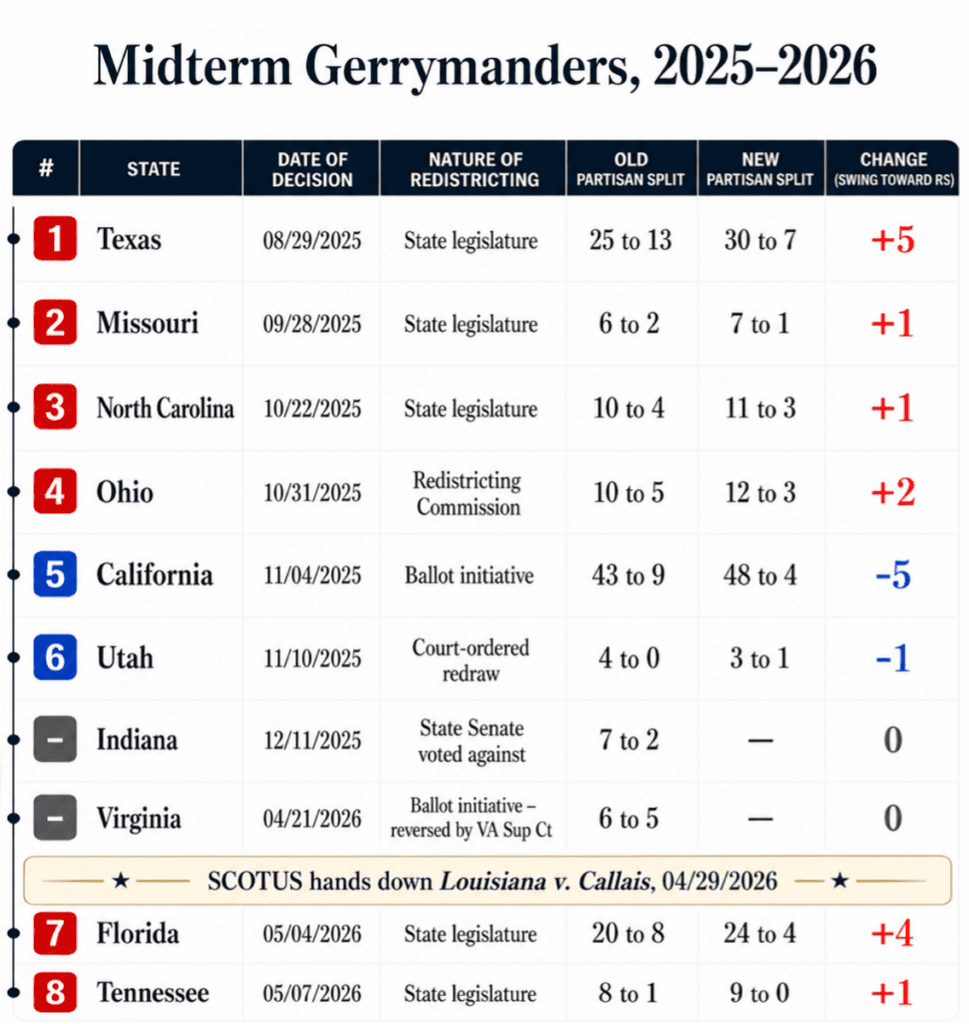
In short, Americans’ partisanship has eclipsed their sense of the importance of local representation. There are still a few holdouts who insist on their commitment to quaint ideas like the integrity of political communities, and they won a battle when they defeated a redistricting effort in Indiana. But most politically active citizens have a hard time understanding why they would pass up the chance to wring out more advantages from districting, if the rules allow it. According to two recent Supreme Court rulings, they do. In 2019, the Supreme Court’s conservative majority signaled its unwillingness to stand in the way of most political gerrymanders, and in 2026, the Court signaled this specifically for majority-minority districts long treated as mandatory under the Voting Rights Act of 1965.
As a result of this shift in ideas of representation toward a winner-takes-all mindset, both Republicans and Democrats have felt the need to purify their states’ congressional delegations. Take Tennessee, which pushed through a change from an 8–1 GOP-majority map to a 9–0 one, splitting Memphis into three districts and Nashville into four. Senator Marsha Blackburn insisted that, since she’s “never heard a liberal bemoan the lack of conservative representation in Massachusetts” or other solid-blue states, the Volunteer State should not hesitate to fulfill its own destiny. “If we are to make Tennessee America’s true conservative leader, this is where it begins,” the possible future governor intoned.
Democrats have sung from the same hymnal in recent months; upon being asked to chair a new state redistricting commission, Senator Angela Alsobrooks averred that “Maryland deserves a fair map that represents the will of the people.” She meant, naturally, that the Old Line State should be a single-line state, with an 8–0 Democrat majority instead of the current 7–1.
Facing the possibility of losing her US House district in Alabama to a new partisan gerrymander, Democratic Representative Terri Sewell drew out this logic to its inevitable end point:
I take 52 seats from California, and 17 seats from Illinois, because at the end of the day, they’re rigging this election to try to win. And we just can’t sit back here and do nothing. We’re going to play their game, and we’re going to beat them at it.
Worry not—modern mapmakers produce such marvels without delay.
At the end of this race to the bottom, we will have refashioned the US House in the image of the Electoral College, with members effectively awarded winner-takes-all by each state.
There is something sickeningly plausible about this eventuality, as it is difficult to say why our current tit-for-tat redistricting war should peter out. At the end of this race to the bottom, we will have refashioned the US House in the image of the Electoral College, with members effectively awarded winner-takes-all by each state. Given how sophisticated partisan mapmakers can be today, if states are determined to make themselves solid red or solid blue, it seems almost ridiculous to bother with the exercise of districting at all. The voting process would be so watered down in this paradigm that it would leave voters with only one choice: Do you want your state represented by Republicans or Democrats? Whichever gets the most votes gets all the seats.
This method is known as “general ticket voting,” and it has been illegal since the Apportionment Act of 1842, passed by a Whig majority that resented too many Democrats being sent to Congress using the method. (They were thumped in the next election.) But if partisans are willing to go that far, why not further? Why empower state parties at all, given how unruly they can be?
That line of thinking leads to an obvious modest proposal: combining the sensibilities of the National Popular Vote Interstate Compact and the recent gerrymandering. This would mean the winner of the election should get the seats: all 435 of them.
And, while we are at it, why not let national parties decide who should fill these 435 seats, given how much Americans focus on national-level politics? Simplest of all would be a process that lets the president and opposing presidential candidate (past or present) choose the members for their parties, finally forcing the House to treat the mandate from American voters with all the seriousness it deserves. After all, we have the Senate to look after all those lesser considerations of state identity, minority voice, and whatever.
But for most of us, it illustrates that for all the talk of the majority’s “right” to govern and the nationalization of American politics, we still believe in an important role for place-based representation.
While we may hope Americans instinctively recoil from this abomination, at this point, many might well embrace it. A certain high-volume social media user residing at 1600 Pennsylvania Avenue seems to be supportive. But for most of us, it illustrates that for all the talk of the majority’s “right” to govern and the nationalization of American politics, we still believe in an important role for place-based representation.
That being the case, we should not allow the dedicated partisans who control most state legislatures to jury-rig a system that gets us three-quarters of the way to this deranged reality by means of district drawing. Since particular communities are the building blocks of our nation, we need to give them steady district lines that allow their elected representatives the chance to express their particular needs. Only through genuine representation of the diverse circumstances in our vast republic can we chart a collective way forward through difficult times.
Despite the steps many states have already taken in the wrong direction, there is still room for a truce in the gerrymandering war. Formally, there are no insuperable difficulties. We could attempt, as Democrats did during their big democracy push in 2021, to require every state to set up an independent districting commission charged with final mapmaking authority. But this approach leaves each side worried that the other will capture or subvert the commission’s processes, and so it might well be worth risking some oversimplifying crudity.
Congress could legislate a rule that all states must follow in their districting, and it could make it as mechanical as possible to minimize the opportunities for gamesmanship. One intuitive option is to require all states to follow existing county or municipal boundaries as much as is feasible and to maximize the compactness of districts. Or there are plenty of more complicated options that take advantage of our massive simulation capabilities; for example, the Algorithm-Assisted Redistricting Methodology Project provides software that can create hundreds of maps that incorporate prespecified criteria, and it might be possible to require adopting the “most neutral” or “most competitive” of the bunch. Political geography is endlessly idiosyncratic, so there are no perfect solutions. But choosing a rule that both parties could live with would leave us much better-off, with more continuity and more genuine competition.
One can also imagine a grassroots movement for reform that feeds on generalized alienation from the current Congress and thereby transcends partisanship.
Of course, de-escalation is not a strength of our current partisan leaders. It is possible to imagine Democrats winning emphatic victories in 2028 and then pushing through “democracy reforms” that include some end to gerrymandering; they might even find some California, Illinois, and New York Republicans to join them, if they keep their efforts narrowly focused. One can also imagine a grassroots movement for reform that feeds on generalized alienation from the current Congress and thereby transcends partisanship. If the movement to expand the House reaches a critical mass, a gerrymandering ban could become part of its effort to restore the connection between representatives and their constituents.
Or perhaps Americans will warm to the even-more-ambitious reform scheme that insists we need some variety of multimember districts with seats allocated by proportional representation. Giving minority parties a path to win seats would transform the mapmakers’ task, introducing enough unpredictability to make it hard for them to predetermine results through their craft.
None of these possibilities seemed at all plausible before our current gerrymandering skirmishes, and they remain long shots. Still, the sheer brazenness of this year’s partisanship has clearly awakened many Americans to the value of meaningful geographic representation. The art of “home style” has surely declined, but the nastiness of “homeless style” may make us revivalists.
Philip Wallach is a senior fellow at the American Enterprise Institute and the author of Why Congress (Oxford University Press, 2023).