


The Declining Birth Rate and Its Associations
Insights from a Dystopian Novel
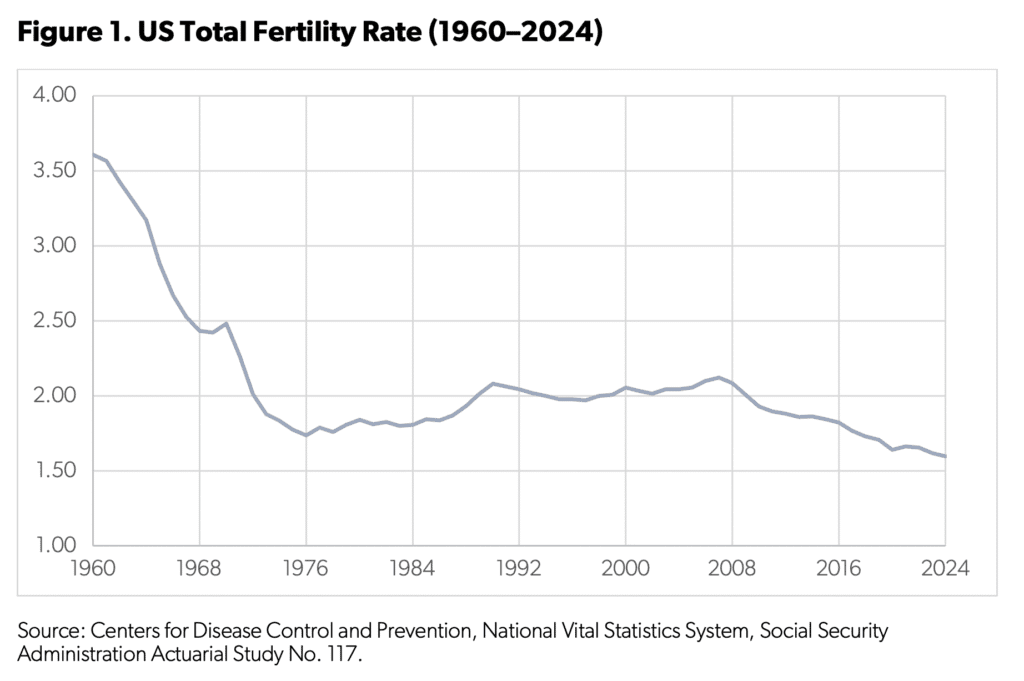
February 26, 2026America, like many other countries, is on a path to population decline. The total fertility rate, which measures the average number of children born to a woman over her lifetime, in the US for 2024 was 1.6—a figure that has consistently fallen since 2007, when it was last at the replacement rate of 2.1. (See Figure 1.) This dramatic drop-off over the past two decades, with no sign of reversal, occurred long after the legalization of abortion and widespread use of birth control, meaning something else is driving the shift.
The sustained decline makes it important to understand what the broad, long-range economic and social consequences and correlations might be in the future or currently, even beyond the obvious growing financial shortfalls of public retirement, health insurance programs, and government budgets. A source of insight into this question is the masterpiece dystopian novel by P. D. James, The Children of Men, published in 1992 and expertly analyzed in Christopher J. Scalia’s 13 Novels Conservatives Will Love (but Probably Haven’t Read).
James’s novel, set in a future 2021 England, tells the story of a lonely, bereaved, divorced 50-year-old man. He is an Oxford history professor treading through life who is suddenly faced with dire moral challenges. The story unfolds in the aftermath of the worldwide, total, and scientifically unexplained sudden cessation of the vitality of human sperm and, hence, all births in 1995. This shock gradually produces widespread despair, lassitude, loss of hope, and strange coping behaviors, as well as pervasive government surveillance and severe policies of control imposed with only a veneer of democracy.
Interest in sex diminishes, despite explicit literature and government provision of pornography. Marriage rates are low, often involving same-sex unions. Suicides increase, and large parties (even christenings) are held for the government-restricted births of pets, over which bitter custody battles are fought during divorces. Foreign workers from low-income countries are brought in to serve essential labor needs, even as new construction halts and whole towns and roads crumble away. These workers are not integrated into society and are sent back to their countries of origin when they age. Fear of crime is widespread, and criminals are deported to a violent penal colony because prisons require too much labor to maintain. Most disturbing are the frequent government-organized, gender-segregated episodes of mass-assisted suicides of the old and infirm. Although nominally voluntary, these assisted suicides are encouraged by the government through pension payments to the next of kin.
Consider real-world statistics in the US that have accompanied the decline in the birth rate and correspond to some of the main social indicators and trends in James’s novel: rising deaths of despair, fewer overall marriages but more same-sex marriages, less interest in sex, greater spending on pets, and the spread of assisted suicides.
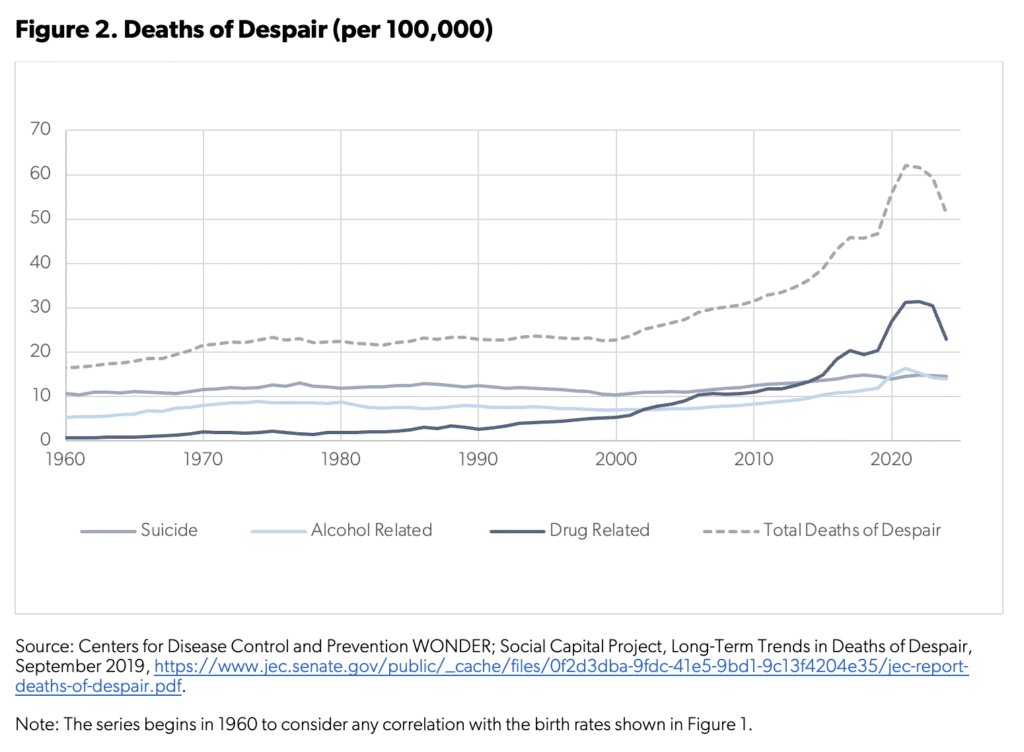
Deaths of despair, which include suicides and alcohol- and drug-related deaths, increased somewhat in the 1960s, held steady through 2000, and then increased noticeably in the early 2000s—especially drug-related deaths (Figure 2). Deaths surged further in the 2010s through 2022, again mainly because of drug-related deaths but also alcohol-related deaths and suicides, and only declined recently, presumably owing to tighter controls on the use of opioids, to a still-high level of 51 per 100,000. As a historical note, the peak rate of deaths of despair was 62 per 100,000 in 2021, following the pandemic’s isolation and restrictions, which was nearly twice the level reached in the financial panic year of 1907 and three times that of the Great Depression year of 1931.
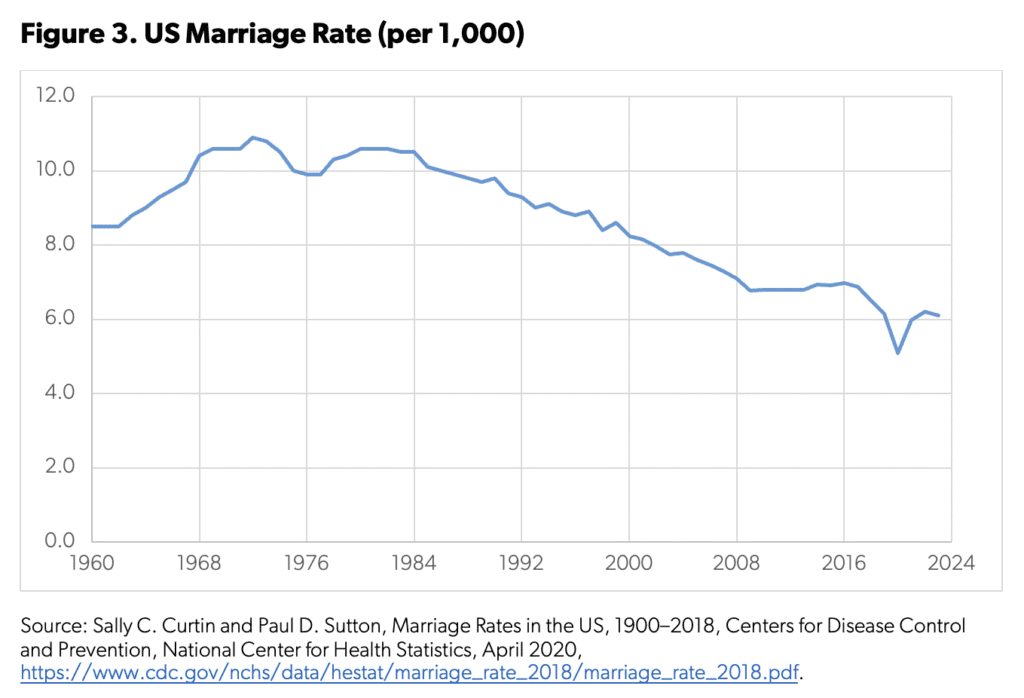
The marriage rate (Figure 3) rose from 8.5 per thousand persons in 1960 to a peak of 10.9 in 1972. It then fell to 9.9 during 1976 and 1977 before increasing to 10.6 from 1980 to 1982. From 1982 to 2009, the rate steadily and deeply declined, and then it stabilized from 2009 to 2017 between 6.8 and 7.0. Since then, it has fallen further, to 6.1 in 2023—the lowest, excluding the pandemic year, on record since 1900. Marriage, being the main social institution for the protection and development of children, is naturally associated with fertility, both as a cause and effect.
As marriage rates have fallen, same-sex marriages have increased (Figure 4). In the US, same-sex marriages were first legally recognized in San Francisco and Massachusetts in 2004. Subsequently, mainly through court actions, they became more widely recognized in many states and cities. In 2014, the first year for which we have statistics, 0.58 percent of all married couples were same-sex. In June 2015, the Supreme Court ruled in Obergefell v. Hodges that the US Constitution guarantees same-sex couples the right to marry throughout the country, despite arguments put forward that states have a substantial interest in supporting and encouraging marriage among opposite-sex couples to highlight the procreative aspects of marriage.
At the time of the decision, 15 states did not allow same-sex couples to marry, and 16 states had just granted same-sex couples the right to marry in the prior year. The percentage of all married couples that are same-sex has since increased steadily to 1.28 percent in 2023.

According to data from the National Survey of Family Growth, a periodic government survey of sexual and family behavior, compiled by sociologist Lyman Stone, “sexlessness” for young adults (age 22–34) increased somewhat beginning around 2014 but significantly more between the 2017–19 and 2022–23 survey waves. Virginity among young adult males rose from 4 percent in 2013–15 to 10 percent in 2022–23, while for young adult females, it rose from 5 to 7 percent over that period. The percentage not having sex in the past year for males rose from 9 to 24 percent over the period, and for females, it rose from 8 to 13 percent. Finally, as an indicator of those who aren’t in a sexual relationship at a given time, the share of males who hadn’t had sex in the past three months rose from 20 to 35 percent and the share of females from 21 to 31 percent. According to Stone, the data indicate that the biggest direct driver of declining sexual activity is the decline in marriage.
Spending on pets, which includes purchases of the animals themselves, pet products, food, and related services including veterinary care, as a share of GDP, has increased steadily since 1960 (Figure 5). This has been supported by rising real household incomes because pet ownership may be considered a luxury good. Particularly notable jumps in relative spending on pets since 2001, however, suggest an increasing preference for pet companionship, most evident since the pandemic, despite more modest gains in median real household income.

According to health care expert Sally Pipes, around 8,700 Americans have died by medically assisted suicide since 1997, when Oregon became the first state to legalize the practice. It is now allowed in 11 states as of September 2025, including in populous states like Illinois and New York.
In other countries, assisted suicide is more common. In the Netherlands, which legalized it in 2002, more than 5 percent of annual deaths are now medically assisted suicide. In Canada, more than 15,000 people died by physician-assisted suicide in 2023—4.7 percent of Canada’s total deaths—and 16,499 in 2024, or 5.1 percent of deaths. Canada legalized physician-assisted suicide in 2016, and the proportion of deaths attributed to that has increased by an average of 31 percent annually since then, including a 16 percent increase in 2023. Most Canadians who choose “medical assistance in dying” (MAID) are between 65 and 80. Yet the number of Canadians age 18–45 opting to end their lives through MAID has also grown, from 34 in 2017 to 139 in 2021. Canada continues to broaden eligibility for physician-assisted suicide. Since 2021, it has included those who are not terminally ill but living in circumstances they themselves deem “intolerable,” and it is scheduled to expand further to people with mental illnesses.
A notable recent suicide was Daniel Kahneman, the Nobel Prize–winning scholar of rational choice, who ended his life in Switzerland at age 90 despite his apparent good health and mental activity, to avoid suffering the expected painful disabilities of old age. This occurrence was covered sympathetically, even favorably, in The New York Times and somewhat less so in The Wall Street Journal.
Unlike in James’s novel, the real-world drop in birth rates is not sharply exogenous but appears mostly to be a choice made by hundreds of millions of people across the globe, individually and through social influences and conditions. Its association with rising deaths of despair, lower marriage rates, sexlessness, increased attention on pets, and assisted suicides is not necessarily causal but does seem to have some structural relationships. There are also likely other factors at work, perhaps mutually reinforcing ones in a dynamic way.
Analyzing data and reviewing a large professional literature, Professors Melissa Kearney and Phillip Levine conclude that the widespread fall in birth rates across many high-income countries is not owing to short-term changes in incomes or prices—that is, purely economic factors—but instead to a broad reordering of adult priorities away from children. According to the literature, this reordering is driven by cultural changes favoring individual autonomy, self-realization, gender equality, interest in career, leisure and friends, and secularization.
Although economic factors are not the cause of the birth rate decline, some economic policies could help ameliorate it. Lower-cost housing, in particular, has been shown to encourage marriage and having children. In the current environment, the best and quickest way to reduce housing costs is to lower interest rates, especially at the long end of the yield curve. This, in turn, is achieved most directly by reducing the government budget deficit and the issuance of debt that competes with other investments and savings. Reducing government deficits and debt would have the additional advantage of creating hope for young households that they will not be burdened with rising taxes or chaotic bouts of inflation and financial crisis in the future. A more prudent fiscal policy would foster an improved and stable economic and political environment in which to raise healthy and happy children. Professor Jesús Fernández-Villaverde adds to housing affordability that reforming the educational system and enhancing the labor and social skills of many young men are appropriate policy reactions.
Although economics as a science has become increasingly technical and abstract, with its reliance on complex theoretical and econometric models, analyses of important issues—like the declining birth rate—could still benefit from “thought experiments,” such as the prescient imagination of great novelists like James in The Children of Men.
Mark J. Warshawsky is a senior fellow and the Wilson H. Taylor Chair in Health Care and Retirement Policy at the American Enterprise Institute, where he focuses on Social Security and retirement issues, pensions, long-term care, disability insurance, and the federal budget.