

A Landmark Tech Ruling and What Lies Ahead
Why the Verdict in Los Angeles on Social Media Addiction May Not Spell Doom for Meta and Google
April 24, 2026When a California jury last month awarded six million dollars in a social media addiction trial to a 20-year-old plaintiff—identified by her initials, K. G. M.—one word dominated media outlets’ description of the verdict: “landmark.” It was the first time a jury penalized a social media company—here, both Meta and Google—for ostensibly injuring a minor this way. While articles from the Los Angeles Times to the New York Post emphasized how this outcome could be a harbinger for a deluge of future rulings against tech companies, the reality is more complex.
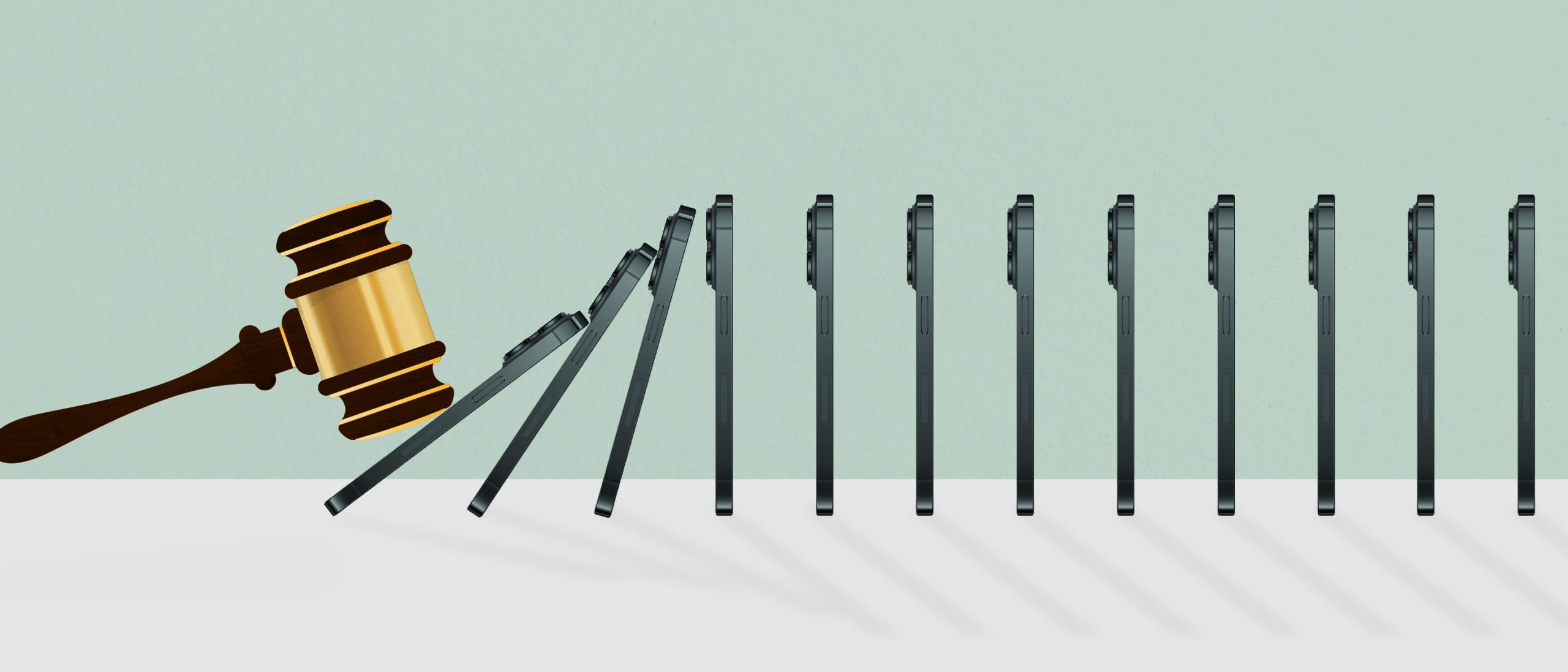
Not all the hundreds of other personal injury cases filed by or on behalf of minors against social media companies will necessarily go the same way. In fact, reasons exist for Meta and Google to be cautiously optimistic that things may turn out differently on the long road of litigation that lies ahead in P. F. (K. G. M.) v. Meta Platforms—the companies are appealing the decision—and the other lawsuits. To grasp why the other cases may not easily fall like dominoes in the plaintiffs’ direction, it is first essential to understand how the “landmark” designation for this case is still apropos and why the outcome upsets free speech advocates.
K. G. M.’s case marked the first time a US jury found social media companies liable for supposedly addicting a minor—through defective “design features,” not via content consumed—to their platforms and causing her numerous mental health harms. The platform design features at issue included structural elements and functions such as engagement-maximizing algorithms, push notifications, infinitely scrolling content on Instagram, and video “autoplay” on YouTube. K. G. M. blamed these features for her emotional distress, depression, anxiety, self-harm, and body dysmorphia.
The 12-person jury voted 10 to 2 in K. G. M.’s favor, holding both defendants liable under two negligence theories—negligently designing or operating their platforms and negligently failing to adequately warn users that their platforms would likely “be dangerous when used by a minor in a reasonably foreseeable manner.” Those theories treat platforms as if they were material products such as cars and coffee makers, not as speech services that convey First Amendment–protected content and allow minors to learn information, engage with others, and express themselves.
I’ve contended that holding platforms culpable for alleged behavioral addictions is clearly distinct from holding tobacco companies liable for substance addictions.
The design-defect treatment of platforms is highly problematic because, as attorney Ari Cohn of the Foundation for Individual Rights and Expression explained, “The minute we start treating speech as if it were just another physical product is the minute we hand the government the power to decide what we can read, watch, and say.” In that vein, I’ve contended that holding platforms culpable for alleged behavioral addictions is clearly distinct from holding tobacco companies liable for substance addictions. When litigation targets social media companies over addiction, expressive constitutional rights come into play. Suing tobacco and cigarette companies, however, does not raise First Amendment concerns, because their products don’t convey expression.
Additionally, and unlike cigarettes, social media platforms offer minors multiple benefits, including allowing them to make friends and social connections, letting them realize and express their identities and beliefs, and providing an interactive forum for learning important information and participating in society. As Jacob Mchangama and Jeff Kosseff wrote about the flawed tobacco-litigation analogy, “The scientific consensus on smoking’s harms is unanimous and no one claims smoking has benefits. Neither is true for social media.” The benefits to minors from social media, however, weren’t at issue in K. G. M.’s case; only the averred downsides were.
In delivering its verdict for the plaintiff, the jury concluded that the defendants’ purported negligence in designing or operating their platforms and failing to warn minors of supposed dangers were “substantial factor[s] in causing harm to K. G. M.” (Emphasis added.) The phrase “substantial factor” has legal meaning. It describes “a factor that a reasonable person would consider to have contributed to the harm” and that is “more than a remote or trivial factor.” It doesn’t, however, need “to be the only cause of the harm.” Importantly—and in pro-plaintiff fashion—the jury was instructed that “a defendant cannot avoid responsibility just because some other person, condition, or event was also a substantial factor in causing K. G. M.’s harm.”
The jury awarded K. G. M. $3 million in compensatory damages and $3 million in punitive damages. It pinned 70 percent of the responsibility on Meta and the rest on Google, which had argued, among other things, that it’s not a social media platform but rather a video delivery service. The punitive damages award meant that the jury decided “K. G. M. [had] proved by clear and convincing evidence that [the defendants] acted with malice, oppression, or fraud.”
When Meta and Google appeal this ruling, there is little doubt that the First Amendment will be central to their arguments.
In winning the case, the plaintiff’s attorneys dodged both potential First Amendment speech defenses and the statutory immunity from civil liability that interactive computer services generally have for harms caused by third-party content they host. Regarding the former constitutional defenses, the US Supreme Court concluded in 2024 that the First Amendment protects the “editorial judgments” of social media platforms when they curate, moderate, prioritize, and deliver lawful content to users. California Superior Court Judge Carolyn Kuhl, however, refused to grant the defendants’ request for a “proposed instruction concerning the First Amendment,” thereby teeing up a key basis for appeal. When Meta and Google appeal this ruling, there is little doubt that the First Amendment will be central to their arguments.
Regarding the statutory defense, the federal law known as Section 230 has afforded immunity from civil liability to platforms for most user-generated content for three decades, thus allowing platforms and the content they host to flourish. Importantly, Section 230 also provides a means for platforms to nip cases in the bud, stopping them early before they become expensive and necessitate time-consuming trials.
Kuhl, however, let the jury sort out whether Section 230 protected the defendants: It had to decide whether it was third-party content on Instagram and YouTube that allegedly harmed K. G. M. or whether it was the platforms’ design features that injured her. The jury concluded it was the latter, but how exactly it parsed out harm caused by the content that K. G. M. consumed from harm caused by the platforms’ design and structural elements is a mystery. Without content, social media would just be a blank page, and no one—neither minors nor adults—would ever engage with it, let alone form an addiction. Kuhl’s decision not to block K. G. M.’s lawsuit from proceeding to trial on Section 230 grounds creates another important ground for appeal.
The outcome in Kuhl’s courtroom is troubling from a free speech perspective because the plaintiff’s attorneys made an end run around both Section 230 and the First Amendment. As Techdirt’s Mike Masnick wrote, K. G. M.’s attorneys found
a formula that works: don’t sue over the content on the platform. Sue over the design of the platform itself. Argue that features like infinite scroll, autoplay, algorithmic recommendations, and notification systems are “product design” choices that are addictive and harmful, separate and apart from whatever content flows through them. (Emphasis in original.)
That winning formula is alarming because, as The Wall Street Journal’s editorial board presciently warned, trial lawyers could now use the Los Angeles verdict to recruit more plaintiffs, including through social media ads. Beyond the floodgates-of-litigation fret, the verdict will embolden lawmakers to draft more laws restricting minors’ access to lawful content on social media platforms rather than letting parents determine and control their children’s usage.
Ultimately, as The Washington Post’s editorial board asserted, verdicts like K. G. M.’s suggest to both kids and parents that businesses—not themselves or their own conduct—are responsible for an increasing number of personal problems. George Will adds that blaming corporations for slippery emotional harms by invoking the concept of addiction promotes the harmful notion that “individual agency is so flimsy and attenuated that accountability for an individual’s behavior must be located beyond the individual. This infantilizing premise leads to paternalism, then to domestic authoritarianism.”
No two cases are exactly alike in terms of their facts, despite overarching litigation themes.
There are, however, numerous reasons to believe that a parade-of-horribles scenario for the social media defendants will not inevitably materialize in the minors’ addiction cases. First, no two cases are exactly alike in terms of their facts, despite overarching litigation themes. Every plaintiff is different, and the myriad variables in a plaintiff’s life that might lead to problems like anxiety and depression—such as family troubles, financial stress, and bullying in school—are unique to them. As professor Eric Goldman of Santa Clara University School of Law wrote, the K. G. M. verdict “is just one datapoint about liability and damages. The other trials could reach divergent outcomes, so this jury verdict isn’t the final word on any matter.”
Second, the K. G. M. trial involved “one of the strongest personal injury cases” among the hundreds pending before Kuhl. It was a case the lead attorneys for the plaintiffs behind the consolidated proceedings pushed to be heard early as a bellwether trial. Despite that fact, it took “roughly 43 hours of deliberations,” stretching over nine days, before the jury finally reached a verdict. Even then, the decision wasn’t unanimous; two jurors would have held neither defendant liable. In sum, these cases are factually complicated, and reaching a pro-plaintiff verdict in what the plaintiffs’ attorneys likely believed was a strong case proved difficult.
Additionally, Mark Lanier—one of the nation’s top trial lawyers—was hired specifically to argue K. G. M.’s case, and he likely won’t be similarly involved in the other trials. As Lanier told Fox News after the jury’s verdict, “I was just hired to try this case. I’m not one of the deepest-involved lawyers” who are handling the social media addiction cases. Lanier, a member of the Trial Lawyer Hall of Fame, apparently has gifts for simplifying matters and courtroom storytelling. The Los Angeles Times reported that he
leaned on his down-home Texas folksiness throughout the trial, telling the jury what was on his heart and scribbling with grease pencil on his demonstrative aids. In his direct addresses to the jury, he used a set of wooden baby blocks, stacks of paper, even a hammer and a crate of eggs.
With Lanier not arguing the other cases, things might turn out differently.
Yet another factor clouding the outcome of future cases is the economics and funding behind them. Personal injury addiction cases are expensive to litigate: Each plaintiff is deposed and examined by therapists, and multiple expert witnesses are hired to testify and prepare reports on matters such as causation of harm. Bloomberg Law reported in March that the Social Media Victims Law Center, one of the lead law firms behind the cases, “has a funding arrangement with Flashlight Capital going back to June 2024.” With funding for third-party litigation in play, one wonders whether the $6 million award to K. G. M. was what the funders had hoped for and whether it’s enough to garner more investors to bankroll the cases.
Third-party funders might be disappointed by the punitive damages award. Lanier suggested to jurors that one billion dollars would be appropriate, given the defendants’ wealth. The Wall Street Journal reported that “when arguing for punitive damages . . . Lanier held up a jar of 415 M&Ms to show how a $1 billion fine would be a fraction of Alphabet’s $415 billion in shareholder equity.” The jury, however, awarded the plaintiff $3 million in punitive damages, leaving Lanier to lament he “would’ve thought it was likely we would have gotten a bigger number.” Or, as NBC News reported, it was just “a small fraction of the $1 billion in punitive damages the plaintiff’s counsel sought.”
Finally, it remains to be seen whether a three-judge appellate court panel will agree with Kuhl regarding Section 230 and the First Amendment. Whether Kuhl made errors of law and whether the jury correctly applied the law will be front and center on appeal, not folksy arguments or illustrations. Lanier won’t be there to show the appellate court judges—as he did for the jurors during his closing statement—“an image of a herd of gazelles surrounded by a lion” and tell them, “I think that’s what we got in this case.” The appellate judges will focus, instead, on legal errors. It could take them more than a year to reach a decision that, in turn, could be appealed to the California Supreme Court and, ultimately, to the US Supreme Court.
In sum, things in March didn’t turn out the way Meta and Google wanted in Kuhl’s courtroom. Predicting what now will happen is a fool’s errand. In many ways, the K. G. M. verdict was merely the opening salvo in a protracted battle. It might take a series of consecutive pro-plaintiff verdicts—ones with large damage awards that are sustained on appeal years later—before settlements could resolve the Los Angeles lawsuits on minors’ addiction. That, too, remains to be seen.
Clay Calvert is a nonresident senior fellow in technology policy studies at the American Enterprise Institute. He is also a professor emeritus of law at the Levin College of Law and Brechner Eminent Scholar Emeritus at the College of Journalism and Communications, both at the University of Florida.