

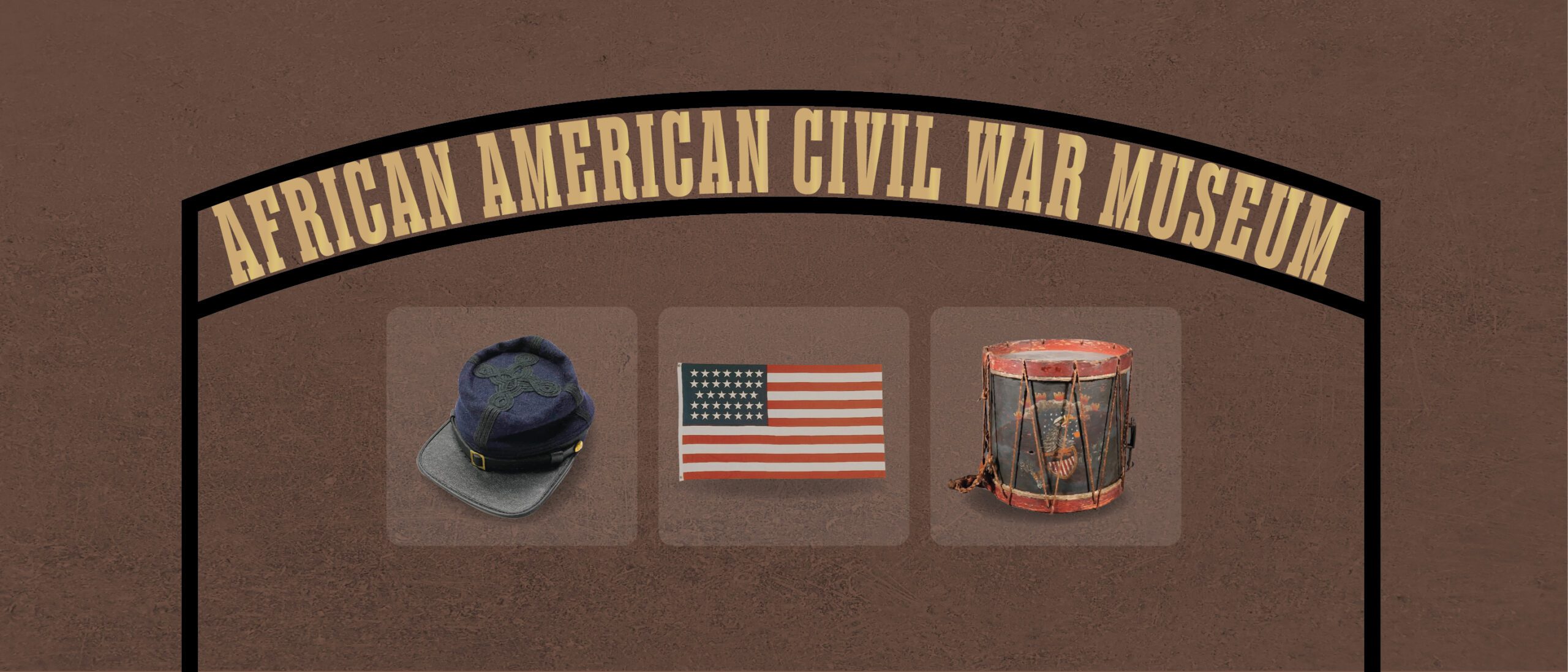
Capturing Patriotism Alongside Injustice
The African American Civil War Museum’s approach to retelling a poignant historical moment.
October 29, 2026Any conservative interpretation of American history must confront the problem of race. Conservatives generally want to present our history in a positive, patriotic way. They correctly sense that there is much to be proud of in our past and that it is both unifying and healthy for American citizens to appreciate our national heritage. Yet there are dark spots in America’s past, and many of them involve racial injustice. Conservative approaches to historical memory therefore face the challenge of vindicating our national story without, however, whitewashing the past or abandoning a commitment to telling the full truth about it. A museum that recently reopened in Washington, DC, shows how this can be done.
The African American Civil War Museum is devoted to the 200,000 or so black men who served in the Union armed forces during the Civil War. It is located in a small, unassuming house—formerly home to the historic Grimke School—in Washington’s U Street district. The museum would be easy to miss, were it not for the statue of a seated Abraham Lincoln in front of its entrance.
It is also conciliatory, highlighting the moments of racial unity in our past rather than presenting American history as nothing but a tale of ceaseless racial conflict.
While the museum’s leadership is not conservative, it approaches the past with a sensibility that conservatives should admire and emulate, and that all Americans could get behind. The exhibits strive to be factually accurate, of course—but what’s remarkable is their tone. It strikes the right notes and evokes the right emotions. It is quietly patriotic, stressing blacks’ contributions to the national story. It is also conciliatory, highlighting the moments of racial unity in our past rather than presenting American history as nothing but a tale of ceaseless racial conflict.
I went to the museum shortly after its reopening on September 30. Dr. Frank Smith, the museum’s director, happened to be at the door when I walked in. He gave me a warm welcome.
The museum has two main sections. Visitors are first shown a video that lays out the basic facts of black soldiers’ participation in the Civil War. They are then directed to another room, which narrates the history of black people in America, from their arrival in the 17th century to the late 20th century, with a focus on the Civil War era. There are also trinkets and artifacts of various kinds, as well as text describing the items you’re seeing and weaving the historical narrative together.
The introductory video is informative and very moving. Both North and South refrained from recruiting black soldiers at the start of the war. The North didn’t want to alienate the border states—the slave states that had remained in the Union—by arming blacks. A law passed in 1792 barred blacks from serving in the US Army, and racism made many Northern whites skeptical that blacks would make good soldiers. The South for its part found the notion of arming blacks to be inconsistent with their founding principles. If blacks could serve capably, they worried, then they might not be as stupid or vicious as proslavery ideology made them out to be.
Military necessity prompted the North to reconsider its policy. Abraham Lincoln passed the Emancipation Proclamation in 1863, freeing all the slaves in Confederate territory, and black recruitment picked up in earnest after it. In May of that year, the War Department established the Bureau of Colored Troops to handle the influx of black soldiers. By the end of the war, around a tenth of the Union Army consisted of black troops.
The film embraces a determined black patriotism, of the sort that says: We have been here from the start, we occupy a central place in the story of this political community, and despite the disdain of so many whites, we insist on our right to belong.
Violins and patriotic tunes, such as the “Battle Hymn of the Republic,” play in the background as the video narrates these facts. It also cites contemporary reports that testify to the bravery and gallantry with which the black soldiers fought, both for their freedom and for the nation. The film embraces a determined black patriotism, of the sort that says: We have been here from the start, we occupy a central place in the story of this political community, and despite the disdain of so many whites, we insist on our right to belong.
The video quotes Benjamin Franklin Butler, a Union general who led black troops and became a US representative for Massachusetts after the war. In 1874, Congress was debating legislation dealing with racial equality. Butler gave a speech saying that witnessing blacks’ courage in battle dissolved his prejudices and converted him to the cause of civil rights. He cited the experience of riding his horse through a field of dead soldiers after a battle at New Market Heights, near Richmond, Virginia:
As I rode along among [the dead troops], guiding my horse this way and that way lest he should profane with his hoofs what seemed to me the sacred dead, and as I looked on their bronzed faces upturned in the shining sun to heaven as if in mute appeal against the wrongs of the country for which they had given their lives, and whose flag had only been to them a flag of stripes on which no star of glory had ever shone for them—feeling I had wronged them in the past and believing what was the future of my country to them—among my dead comrades there I swore to myself a solemn oath, “May my right hand forget its cunning and my tongue cleave to the roof of my mouth if I ever fail to defend the rights of these men who have given their blood for me and my country this day and for their race forever” and, God helping me, I will keep that oath.
Across the street from the museum there is a memorial to the black Union troops. It has a sculpture of soldiers holding their weapons. Behind them is a wall listing the names of all the black soldiers who fought, as well as the 7,000 white officers who led them in battle. The video, which was filmed in the early 2000s, shows an older black veteran visiting the memorial, pointing to the name of an ancestor who also fought for the US Army, and beaming with pride. I went to the second exhibit with a knot in my throat.
Wall text at museums is often written in a neutral and dispassionate style, and while this may well be appropriate for many museums, it can also be dull for readers. The African American Civil War Museum doesn’t suffer from this problem. The prose on its panels is captivating. A didactic text discussing the struggle for civil rights reads:
Between 1950 and today, Blacks, whites and others joined in freedom rides, mass marches, boycotts, sit-ins, and voter registration drives to make real the “equal protection under the laws” promise of the Constitution. They were met with violence; they were jailed; they were tear-gassed; and some were killed. Nevertheless, in word and in song, they promised to “never turn back.” Following in the legacy of the United States Colored Troops, people with courage and commitment are working to make America a better place and make freedom and democracy a reality for all citizens.
And it does all of this without ever taking attention away from the main heroes of its story, the black Union soldiers themselves.
The panels present information in a very balanced way, giving visitors a full picture of the relevant content. For instance, the parts dealing with slavery mention that African tribes were also involved in the slave trade, and the narrative of the Civil War discusses the racism that black soldiers sometimes faced in the Union Army itself. A touch of generosity—that is, a willingness to delight in the goodness of other people—also pervades the entire museum. It gladly acknowledges the white friends of the black freedom struggle, with its statue of Lincoln at the front, its engraving of the names of white officers on the memorial, and its recognition that many whites joined the 20th-century movement for civil rights. It even extends some grace to the Confederacy, though no more than it deserves. While the museum unequivocally condemns the horrible evils of slavery and rightly identifies slavery as the central cause of the Civil War, it also refrains from indulging in resentment and rage against the Confederate dead. And it does all of this without ever taking attention away from the main heroes of its story, the black Union soldiers themselves.
The historian Johann Neem has said that most Americans embrace a historical sensibility that “combines a narrative of progress with acknowledgments of America’s wrongs and an emphasis on struggles for justice and equality.” That is essentially what the museum delivers: an account of history that is honest, that doesn’t romanticize the past, but that is also unifying and inspiring.
When I was finished with the exhibits, I asked the staff if I could speak to the director, Dr. Smith. I told them that I was planning to write about the museum and that I’d love to ask him some questions.
Dr. Smith came out a few moments later. He is 84 years old and still very sharp. He worked with the Student Nonviolent Coordinating Committee as a young man, before getting a PhD in urban planning and going into politics in Washington, DC. He asked me which think tank I work for, and when I said AEI, he joked, Ah, so you are on the other side. Yes, I said, though hopefully on a sensible part of it.
We sat down and chatted for a bit. He told me that the museum has changed a bit since its inception in 1999. They have added some artifacts, and there is a new exhibit tracing the history of Michelle Obama’s ancestry that hasn’t yet opened to the public. I asked him, What do you see as the purpose of the museum? What is it trying to accomplish? “To tell the story of the soldiers, and put them in context,” he said.
As I was leaving, Dr. Smith gave me his card and asked me to write him if I found any inaccuracies in the exhibits. I immediately understood the source of the museum’s generosity and largeness of heart.
Christian Alejandro Gonzalez is a research fellow at the American Enterprise Institute.