


The Golden Age of Public Housing—and Why It Didn’t Last
What we need now is naturally occurring and affordable housing.
September 25, 2025This essay is adapted from Howard Husock’s new book, The Projects (NYU Press), which traces the history of public housing to contemporary debates on the government’s role in the housing market.
If Americans have any shared image of public housing, it is one of dilapidated and even dangerous “projects” and locations of concentrated poverty. But there was a time—a brief shining moment—in which public housing was new and attractive and working married couples with children were glad to live in government-owned and -managed apartments. What might be called the golden age of public housing lasted from the late 1940s to the mid-1960s. To understand how today’s crime-addled complexes can be set on the right course, we must first examine the beacon of progress public housing once was.
In the first two decades after the Housing Act of 1949, President Harry S. Truman pledged to replace neighborhoods branded as “slums” with up to 800,000 public housing units. It was a time recalled fondly and nostalgically by the one-time residents of public housing projects such as Chicago’s Robert Taylor Homes, the Pruitt-Igoe high-rises of St. Louis, and the Brewster-Douglas Houses in Detroit—all of which were later condemned as “severely distressed” and demolished as unsalvageable.
As we continue to struggle to find ways to create housing families can afford and to make the best use of remaining public and subsidized housing, it’s important to understand why “the projects” briefly flourished as working-class apartments and later became de facto poorhouses with daunting maintenance problems that led to widespread demolition.
The fond memories of public housing’s golden age have been captured by extensive tenant oral histories, including those at a National Public Housing Museum in Chicago. Stories laced with nostalgia include those of Chicago’s public housing systems—of one of the nation’s largest—collected in a book tellingly titled When Public Housing Was Paradise: Building Community in Chicago. The author, J. D. Fuerst, recounts the oral histories he collected and what he calls a longing for “the almost bucolic world of public housing in the 1940s and the 1950s,” where the housing complexes were like “extended communities” and tenants assumed the responsibility for “cleaning hallways and porches and other common areas.” Fuerst’s interviews include one with Bertrand Ellis, a retired bank executive who lived with his parents in Chicago’s Ida B. Wells project from 1941 to 1955. The project, named for a legendary anti-lynching crusader, was later captured as a drug-infested, racially segregated dystopia by the filmmaker Frederick Wiseman. It did not start out that way, though.
“Life in Ida B. Wells was a wonderful experience for us,” said Ellis. “Three buildings formed a triangle and in the middle of that triangle was a playground. We grew up playing football, baseball, hockey. . . . We were poor kids in a poor neighborhood, but we didn’t know we were poor, really. We have everything kids could want.”
Another onetime tenant similarly recalled Cabrini-Green, the Chicago project combining row houses with 23 high-rise towers, bordered but not crossed by local streets. “You know, when I hear people say, wow, the projects are so tough and this and that, oh, that didn’t happen until later. It was a wonderful place to live, and I remember mixed races in the projects. We would have basketball tournaments and programs, and we would have a place called the Lower North Center in the Cabrini-Green Projects where young people could go participate in activities, . . . play basketball, do arts and crafts, take little field trips, and there were activities when I was growing up in the Cabrini-Green.”
So, too, were there once fond memories of the soon-to-be-notorious Pruitt-Igoe, the high-rise complex of 33 11-story buildings in St. Louis that replaced the frame houses of the Desoto-Carr neighborhood: “It was a big beautiful place, like a big hotel resort,” recalled Ruby Russell, an early tenant of the high-rise towers and campus grounds. “It was like an oasis in the desert. All this newness. I never thought I would live in that kind of surrounding.”
“It was a big beautiful place, like a big hotel resort,” recalled Ruby Russell, an early tenant of the high-rise towers and campus grounds.
Detroit’s Brewster-Douglass Projects ran five city blocks long and three city blocks wide, including six 15-story high-rise towers. It was in this complex that Mary Wilson met Diana Ross and Florence Ballard and formed the famous Motown group The Supremes. “Moving into the projects as a child was like moving into a wonderland for me,” Wilson would later recall in an interview.
These stories from past residents show that safe public housing was not an aberration limited to a single city but a model of community replicated across the country.
The conditions that made this golden age possible would not last, however. What began as attractive new apartments—with refrigerators and laundry facilities, both still new amenities in the early postwar era—would, as would any building, require funds to be reserved for upkeep and repairs. It was, crucially, assumed that residents would pay rents sufficient to provide for the upkeep. A federal entity—the US Housing Authority—had guaranteed local housing authority bonds to finance construction. But ongoing expenses were meant to be covered by rents. It was a model that worked—until it didn’t.
What began as attractive new apartments—with refrigerators and laundry facilities, both still new amenities in the early postwar era—would, as would any building, require funds to be reserved for upkeep and repairs.
In the 1950s—an era described in Nicolas Dagen Bloom’s book, Public Housing that Worked—local housing authorities could be picky about potential tenants. In New York, single parents were excluded in favor of married couples. So, too, was employment required as a means to assure rent payment.
But even though more than 1 million public housing units were built in some 3000 municipalities—including not only big cities but the small towns of the Deep South—a major, countervailing and ultimately competitive source of new housing was emerging: the split-levels and ranch homes in burgeoning suburbs, with mortgages guaranteed by the federal government.
The extent of movement to the suburbs during the 1950s and 1960s cannot be overstated. As the historian Kenneth Jackson has noted in Crabgrass Frontier, his discussion of the post–World War II rise of the US suburb, between 1934 and 1960, some 12,166 mortgages were taken out by homebuyers in the city of St. Louis. In contrast, a staggering 63,772 mortgages were provided to new buyers in outlying St. Louis County. With help from the same federal government that had supported the construction of Pruitt-Igoe, the employed, rent-paying tenants for public housing were fleeing the city, and cities in general.
The extent of movement to the suburbs during the 1950s and 1960s cannot be overstated.
Jackson details similar outflow figures for New York, with 87,183 mortgages in suburban Nassau County compared to just 15,483 in Brooklyn. The same was true in the Washington metropolitan area, where 44,432 mortgages in suburban Maryland and Virginia counties stood in stark contrast to the just 8,038 taken out in the District of Columbia. “This same result,” concedes Jackson, “might have occurred in the absence of all federal intervention. But the simple fact is that the various government policies toward housing [had] the same effect from Los Angeles to Boston.” As Jackson notes, by the end of 1972, the Federal Housing Administration “had helped 11 million Americans buy homes,” and the “number of owner-occupied dwellings rose from 44 to 63 percent.” Crucially, homeownership was a way to accumulate wealth, something with which government-owned rental housing could not compete.
It was during that same period that low-income, single-parent households began to become the predominant tenant group in public housing. The paradigmatic example was that of the Pruitt-Igoe complex. It was the quintessential prototype of the modernist ideal embraced by the public housing visionaries of the 1930s, who successfully sold the concept to the Roosevelt New Deal and Truman Fair Deal. Designed by the modernist architect Minoru Yamasaki, it was lauded by Architectural Forum as a successful example of “slum surgery” and praised, when it opened in 1954, as the “best high apartment of the year.” Just 16 years later, it was the subject of a book-length study by Harvard sociologist Lee Rainwater entitled Behind Ghetto Walls: Black Families in a Federal Slum, which warned that: “Pruitt-Igoe houses families for which our society seems to have no other place. The original tenants were drawn very heavily from several land clearance areas in the inner city.”
The study goes on to note that, although there was originally a mix of races living in the complex, the population of the building later consisted entirely of low-income black Americans. Over half the households in the complex were headed by single women, and more than half derived their principal income from public assistance of one kind or another. Many families living in the complex were so large that they could not find housing elsewhere. Only those who were desperate for housing were willing to live in Pruitt-Igoe.
Many families living in the complex were so large that they could not find housing elsewhere.
Transcripts of resident interviews recounted the sordid conditions of daily life. “There’s too much broken glass and trash outside. The elevators are dangerous,” one said. In 1972, demolition of the entire complex through a dramatic implosion would begin, less than 20 years after the ribbon had been cut.
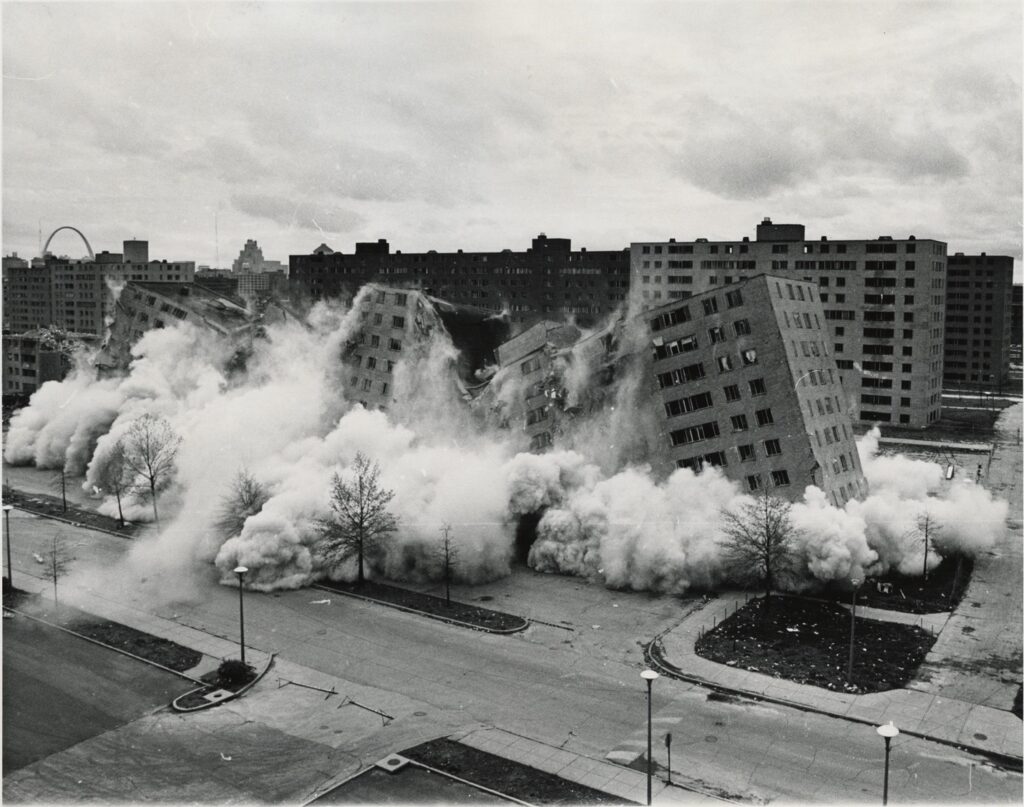
Demolition of Pruitt–Igoe Complex, US Department of Housing and Urban Development Office of Policy Development and Research.
The Pruitt-Igoe implosion is the perfect symbol of the end of the public housing golden age. It was specifically referenced by President Richard Nixon in 1973 when he announced a moratorium on new public housing construction. Its troubles, however, left a significant policy hangover. A rent strike at the complex—by tenants who could not afford the rents the local housing authority knew it needed for maintenance—led to a new federal rule: Public housing tenants would pay no more than 25 percent of their income in rent. The result was a revenue tourniquet for public housing authorities across the country, as they went downhill toward a 1992 federal report that described many of the projects erected to replace slums as themselves “severely distressed”
The working-class tenants who, during the golden age, had paid the bills for public housing had moved on. Many viewed the projects in retrospect in a way that had not been part of the original mission: as a starter apartment, rather than a permanent home. In Memphis, a group of one-time tenants of the Lauderdale Courts project later gathered regularly once they had left it behind. They called their group “Poor Boys Done Good” to highlight their journey from living in subsidized housing to stable adulthood. Their former Lauderdale neighbors included the young Elvis Presley, who would definitely go on to leave the building.
Even as the golden age of public housing has long since ended, there remain some 878,000 public housing apartments in the US. These are complemented by 2.7 million “Section 8” private units whose rents are subsidized through publicly-funded “housing choice vouchers,” a program initiated by the Nixon administration following its public housing moratorium.
Even as the golden age of public housing has long since ended, there remain some 878,000 public housing apartments in the US.
If there remains a role for the overall program, it may be as a place from which the poor can start out with some assistance and then move out and up—that is, to “make good.” In that spirit, the Trump administration has proposed a tenant time limit, in keeping with the federal time limit on cash welfare. This would be a new vision of public and subsidized housing, one more in line with American values.
In many ways, public housing was an original policy sin, one which led to the demolition of working-class neighborhoods and the creation of ‘projects’ that quickly deteriorated. To make the best of what’s left, we should seek to encourage the building of affordable, albeit modest, private housing that is “naturally affordable”: small homes on small lots. Crucially, that will require more relaxed zoning laws. For those in public and subsidized housing, new rules should limit the length of their tenancies and encourage upward mobility. Housing has always been a means to realize the American Dream and can still be.
Howard Husock is a senior fellow in Domestic Policy Studies at the American Enterprise Institute (AEI), where he focuses on municipal government, urban housing policy, civil society, and philanthropy. His latest book, The Projects (NYU Press), traces the history of public housing to contemporary debates on the government’s role in the housing market.